The organisers of Expo 2027 Belgrade spent Thursday, 22 October, in Vienna, the latest stop on a promotional tour of European capitals. The "Visit Serbia" business day at the Hilton Vienna Waterfront brought Austrian and Serbian companies and tourism professionals together for a press conference, a panel and B2B meetings.
The Vienna event followed similar meetings in Zagreb and Ljubljana earlier in the month. Together with new details from the American team, the past week has given a clearer picture of how some of the larger participants plan to use their pavilions, and how many people and companies they intend to bring.
Austria: the Danube as a business bridge
Austria arrives with deep commercial roots in Serbia. Igor Kovačević, executive director of Expo 2027 Belgrade, said in Vienna that more than 800 Austrian companies operate in Serbia. Figures from the Austrian Embassy, cited in the organisers' release, put Austrian investment at about €3.5 billion and employment at around 26,000 people.
Austria's pavilion, Join the Flow, uses the Danube as its central story, with a media-driven "river" guiding visitors through interactive zones and a flexible Innovation Lab with rotating content. InPark Magazine has named facts and fiction, ZONE Media and PLANET architects as its designers. Alf Netek, the deputy Austrian section commissioner, told the Vienna panel that success depends on mixing information, learning and entertainment with direct visitor interaction.
Telekom Srbija also spoke on the panel. Its representative, Jasna Protić, said the company has had around 200 staff working on the Expo for about three years. According to Tanjug, the site's telecom backbone includes 46 km of optical fibre, 49 radio stations, a standalone 5G network and Wi-Fi 7. That is useful for AV and interactive-installation teams planning connected exhibits.
The US pavilion leans into sport
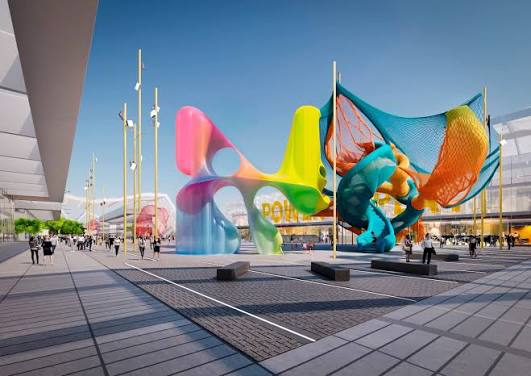
The United States has started to reveal its approach. Charles Pappas, an Expo expert advising the US team, said the pavilion will bring well-known athletes to Belgrade and promised a design that "pushes the boundaries". He suggested, while stressing it was his own guess, that it could centre on a playable sports court surrounded by large LED-clad sculptures, music and lighting effects. No design has been officially published yet.
Slovenia: a pavilion and 2,000 companies
In Ljubljana, Expo director Danilo Jerinić said almost 2,000 Slovenian companies are expected to take part in the exhibition in some form. The Slovenian Chamber of Crafts and Small Business signed a memorandum with Expo 2027 and will act as the central contact point for Slovenian firms. Slovenia's pavilion will cover 324 square metres, next to the Serbian National Pavilion.
Organisers now cite more than 140 confirmed international participants, above the 117 recorded at Astana in 2017, and expect more than four million visits between 15 May and 15 August 2027.
Why this matters for Serbian event professionals
The figures from Austria and Slovenia point to a busy programme beyond the pavilions themselves. Business delegations of this size need meeting rooms, receptions, transport, interpreters, staging and branded spaces, much of it outside the Expo site. Venue owners and event agencies in Belgrade should expect enquiries from national chambers of commerce, not only from pavilion teams.
For fit-out contractors, the Austrian and US concepts are a reminder that most pavilions will be media-heavy. Firms offering LED, projection, interactive installations and technical maintenance during the 93-day run are likely to be in demand. Since the lead designers are often foreign studios, the opening for local companies is usually in delivery and on-site support. The organisers say more meetings with European markets are planned in the coming months.
Sources
- www.prnewswire.co.uk
- www.tanjug.rs
- www.b92.net
- www.b92.net
- www.b92.net
- www.inparkmagazine.com