The headline number is back in circulation. Late last week Serbian media again ran the forecast that Expo 2027 Belgrade could add €9.07 billion in new value to the economy by 2037, this time alongside the government's "Leap into the Future – Serbia Expo 2027" programme, which targets a GDP of €100 billion in 2027.
The figure comes from a study by the consultancy Louis Berger Adria on the economic, social and environmental effects of the exhibition, first presented in August. It was chosen through public procurement in September 2025 for 68.9 million dinars including VAT. For companies that build, fit out, decorate or host events, the total matters less than the detail underneath it: when the money is expected to move, and through which sectors.
What the Expo 2027 impact study actually says
The study covers three phases: preparation (counted from 2023), the three months of the exhibition itself, and a ten-year legacy period up to 2037. It includes direct, indirect and induced effects.
The main figures, as published by the organisers and in Forbes Srbija's review of the study reported by Biznis.rs:
- €9.07 billion in gross value added by 2037.
- About €3.8 billion in tax revenue, or 1.91 dinars of taxes for each dinar of public money.
- About €2 billion of public investment and about €1.84 billion of private investment. Of the public part, around €1.23 billion goes to the Expo complex and €775 million to supporting roads, rail, water, sewerage and energy.
- Around 359,000 jobs, counted as full-time equivalents.
- 1.65 million foreign visitors during the exhibition, more than 1.13 million of them staying several days.
The National Stadium is not included, because it is formally not part of the Expo. A conservative scenario, with 30% fewer foreign visitors and 10% lower tourist spending, still gives €7.87 billion in value added and more than €3.16 billion in taxes.
When the money flows
The phase breakdown is the most useful part for the events trade. According to the Forbes analysis, about €2.5 billion of the value added comes before the opening, €1.13 billion during the 93 days, and €5.43 billion, roughly 60%, in the ten years afterwards.
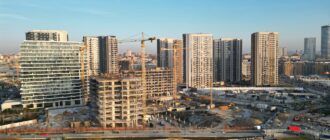
In practice that means the near-term opportunity is in construction, fit-out and preparation, which is happening now. The pavilion handovers to participating countries, interior works, stand building and AV installation all fall into the pre-opening window. The largest block of value, though, depends on what happens to the site after 15 August 2027.
Tourism is the biggest single driver: the study projects €3.22 billion in economic effect from it. Its spending assumptions are worth a look for anyone selling hospitality or event space. Day visitors are expected to spend around €103 each. Visitors staying about three and a half days are modelled at €137 a day for ordinary tourists and €468 a day for business travellers, while 3,215 official delegates are assumed to spend €250 a day.
The sceptical view
Not everyone accepts the numbers. Forbes Srbija editor Ivan Radak told N1 that the study came too late, after Serbia had already bid for the Expo, and called the target of 1.65 million foreign visitors unrealistic. He also questioned whether the complex can be run profitably afterwards, pointing to the Belgrade Fair's record, and said the ten-year payoff rests on "a very uncertain 'if'" of good management.
Costs are a separate debate. In June, Serbia's Fiscal Council estimated that the Expo and associated projects could cost up to €3.4 billion, and said spending spread across many budget lines makes the full figure hard to assess. Forbes itself stresses that the study's results are projections whose accuracy will only be known after 2037.
What it means for contractors, decorators and venues
Three practical points follow.
The pre-opening window is the firm part. Work tied to construction, pavilion interiors and preparation is already contracted or being tendered. That is the money least exposed to visitor forecasts.
Business visitors are the high-value segment. At €468 a day in the model, they are worth more than three times an ordinary tourist. Belgrade venues, caterers and AV firms that can handle receptions, side events and B2B meetings in the city are best placed to capture that spending, whatever the final visitor count.
Plan for the cautious case. If foreign visitor numbers fall short, the conservative scenario still forecasts substantial value, but hotel and event demand during the summer would be thinner. Pricing and staffing plans built on the headline numbers carry more risk than those built on the lower ones.
Companies outside Belgrade can hear how to get involved at the next Expo business presentation, organised with the Regional Chamber of Commerce of the Zlatibor District in Užice on Tuesday, 27 October, at 14:00 (Dimitrija Tucovića 52). The organisers say the programme covers supplier roles, partnerships and a B2B platform for arranging meetings with Expo participants.
Sources
- expobelgrade2027.org
- biznis.rs
- mondo.rs
- n1info.rs
- n1info.rs
- www.tanjug.rs
Photo: Nikola Aleksic / Unsplash licence / source